
Project Information
- Category: AI & Materials Science
- Synthesis Method: Polyol Process
- Duration: 2025 - current
- Institution: Middle East Technical University
- Status: Active Development
AI-Driven Nanowire Production
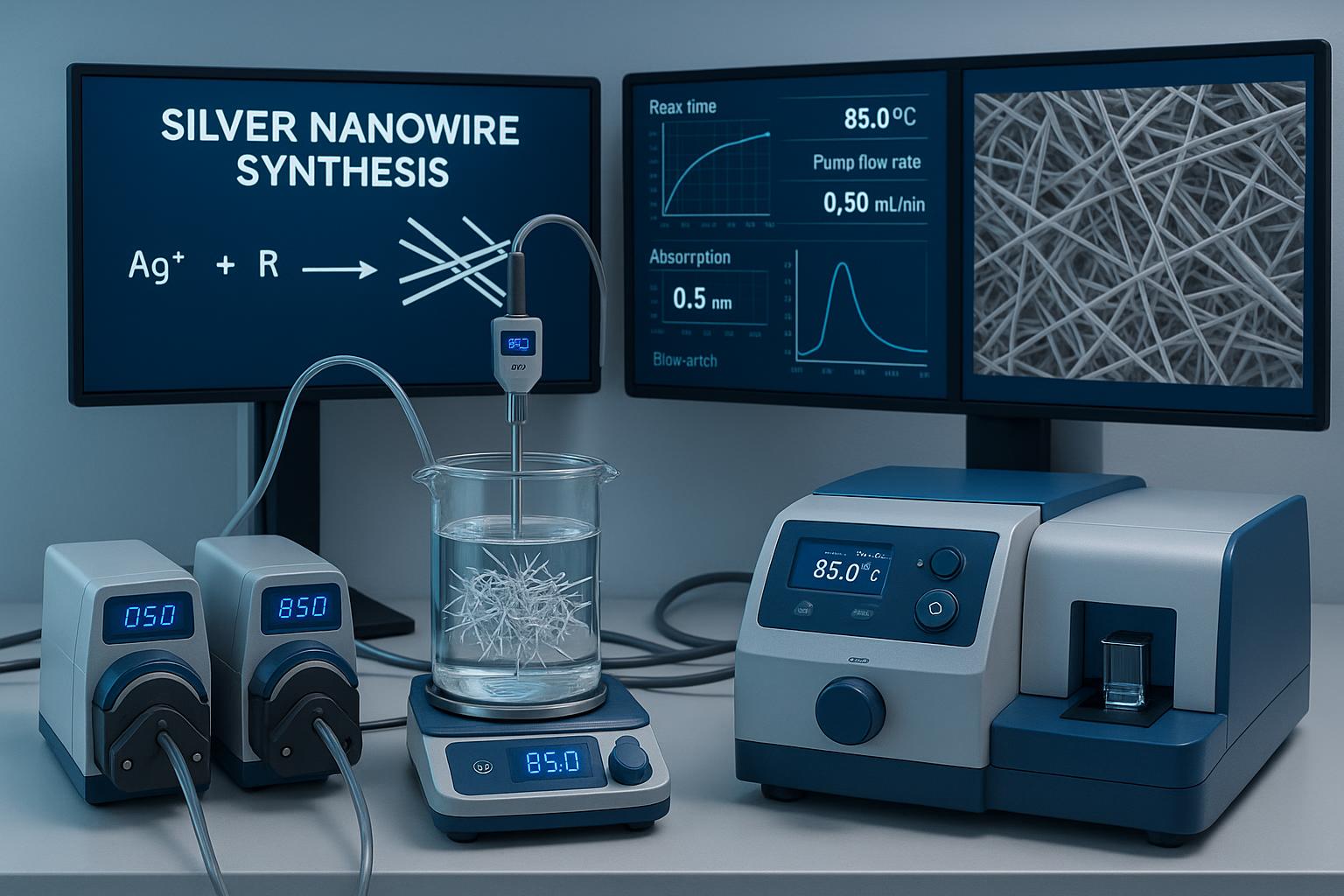
This autonomous laboratory system represents a breakthrough in silver nanowire synthesis through intelligent process control and real-time characterization. The platform integrates polyol synthesis with advanced spectroscopic monitoring to achieve precise control over nanowire morphology and quality.
Autonomous Silver Nanowire Synthesis Platform
Advanced Polyol Synthesis Control
The platform employs a sophisticated polyol synthesis approach with precise control over four critical reagents. Ethylene glycol serves as both solvent and reducing agent, with volume control enabling optimization of reaction kinetics and nanowire growth rates. Silver nitrate (AgNO₃) concentration directly influences nucleation density and final nanowire yield, while polyvinylpyrrolidone (PVP) acts as a shape-directing agent and stabilizer, controlling nanowire aspect ratio and preventing aggregation. Sodium chloride (NaCl) functions as a nucleation mediator, enabling fine-tuning of nanowire diameter and length distribution through controlled chloride ion concentration.
Intelligent Process Parameter Optimization
The system incorporates advanced process control with three key parameters optimized through machine learning algorithms. Temperature control up to 160°C with PID feedback ensures precise thermal management throughout the synthesis process, enabling reproducible nucleation and growth kinetics. Stirring speed optimization up to 500 RPM provides uniform mixing while preventing mechanical damage to growing nanowires. Reaction time control allows systematic optimization of nanowire aspect ratio and yield, with real-time monitoring enabling dynamic adjustment based on spectroscopic feedback.
Real-Time Spectroscopic Characterization
The platform integrates comprehensive spectroscopic monitoring for in-situ quality assessment and process optimization. UV-Visible spectroscopy across 415-680 nm provides real-time analysis of nanowire formation, with peak analysis at λ_max = 480 nm enabling accurate diameter estimation of approximately 110 nm. The system automatically correlates spectral features with nanowire morphology, providing immediate feedback on synthesis quality and enabling rapid process adjustment.
Near-Infrared Transmittance Analysis
Advanced NIR spectroscopy from 940-1550 nm enables detailed analysis of nanowire surface chemistry and stabilizer binding. The system detects PVP binding through characteristic absorption at 1450 nm, providing critical information about surface functionalization and stability. This real-time analysis ensures optimal stabilizer coverage while minimizing excess PVP that could impact electrical conductivity in final applications.
Applications in Transparent Electronics
The synthesized silver nanowires find critical applications in next-generation transparent conductive electrodes for flexible electronics, touch screens, and solar cells. The controlled aspect ratio and diameter distribution achieved through this autonomous system enable optimization of electrical conductivity while maintaining high optical transparency. The platform addresses the growing demand for indium-free transparent electrodes in sustainable electronics manufacturing.
Machine Learning Integration and Process Optimization
The system employs advanced machine learning algorithms for autonomous process optimization and quality prediction. Historical experiment data enables predictive modeling of nanowire properties based on synthesis parameters, while real-time spectroscopic data provides feedback for dynamic process adjustment. The AI optimization module continuously learns from synthesis outcomes, improving parameter selection and reducing batch-to-batch variability.