
Project Information
- Category: AI & Materials Science
- Total Experiments: 147 Completed
- Duration: 2025 - current
- Institution: Middle East Technical University
- Status: Active Development
Autonomous Materials Discovery
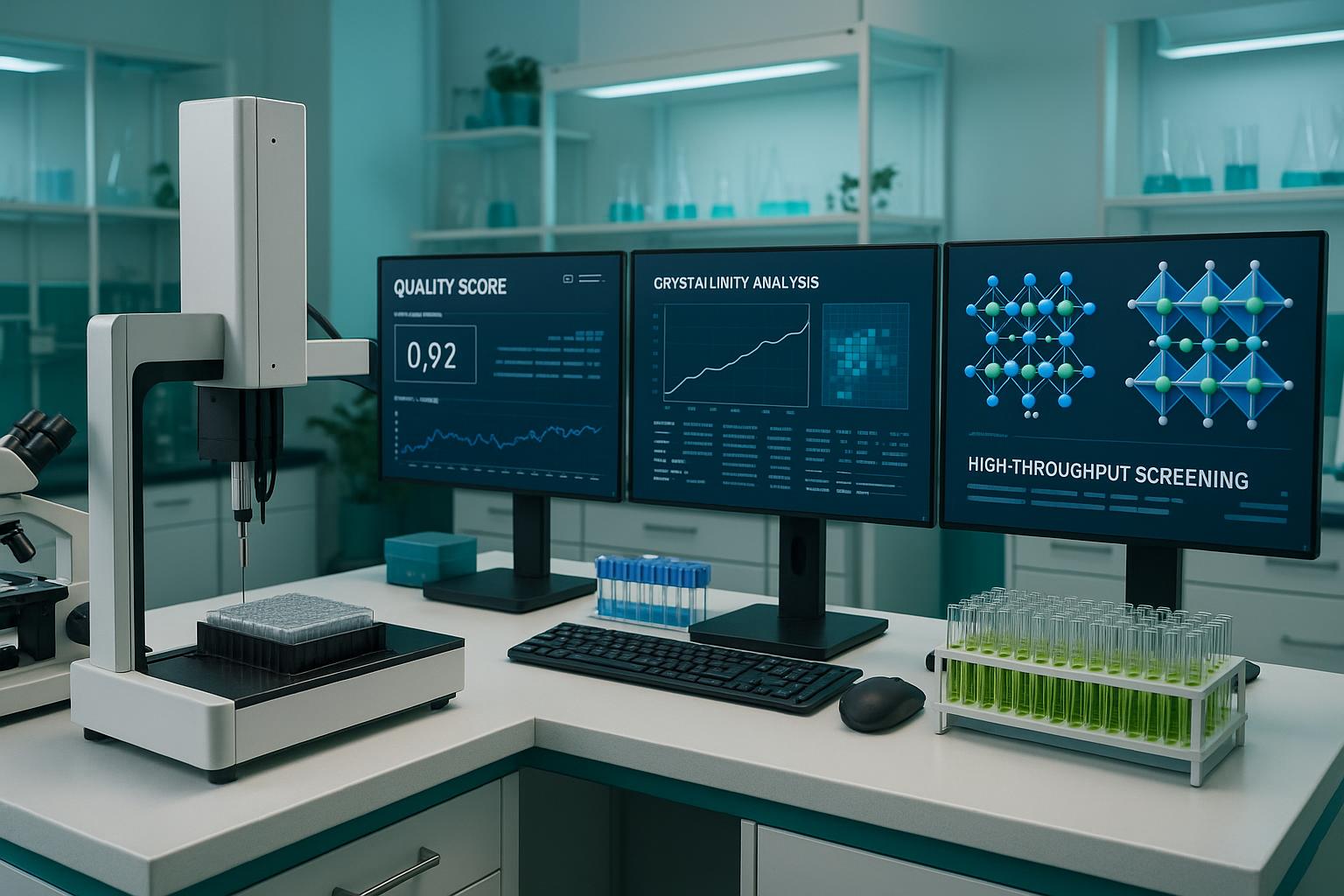
This cutting-edge platform represents a paradigm shift in perovskite materials discovery through autonomous machine learning-driven synthesis and optimization. The system has successfully completed 147 experiments with continuous quality improvement and intelligent parameter selection.
Machine Learning-Driven Perovskite Optimization Platform
High-Throughput Autonomous Synthesis Campaign
The platform has successfully executed a comprehensive materials discovery campaign with 147 completed experiments representing 73.5% progress toward the 200-experiment target. The systematic approach employs machine learning algorithms to intelligently select synthesis parameters, achieving an impressive average quality score of 0.782 across all experiments. The campaign has identified 42 high-quality candidates representing 28.6% of completed experiments, demonstrating exceptional efficiency in materials discovery compared to traditional trial-and-error approaches.
Advanced Composition and Process Optimization
The system explores complex perovskite compositions through systematic variation of formamidinium (FA) and cesium (Cs) ratios combined with precise temperature control. Representative high-performing compositions include FA:0.76 Cs:0.38 synthesized at 176°C achieving quality score 0.971 with crystallinity 0.944, and FA:0.94 Cs:0.13 at 84°C reaching quality score 0.953 with crystallinity 0.931. The platform demonstrates remarkable versatility in identifying optimal synthesis conditions across diverse composition spaces, with temperature ranges spanning from 84°C to 176°C while maintaining consistently high quality metrics.
Dual-Objective Quality and Crystallinity Optimization
The platform employs sophisticated multi-objective optimization algorithms to simultaneously maximize both overall quality scores and crystallinity metrics. Exceptional results include EXP_104 achieving the highest quality score of 0.975 with crystallinity 0.941, and EXP_110 reaching quality score 0.941 with crystallinity 0.780, demonstrating the system's ability to balance multiple performance criteria. The continuous quality score progression over the last 30 experiments shows sustained improvement, indicating effective machine learning integration and parameter optimization.
Real-Time Process Monitoring and Control
The autonomous platform incorporates comprehensive real-time monitoring with live status updates showing current synthesis activities including 3 active synthesis experiments and 2 characterization processes. The system maintains continuous quality assessment with real-time feedback enabling dynamic parameter adjustment based on intermediate results. Advanced process control ensures reproducible synthesis conditions while enabling systematic exploration of parameter space for optimal materials discovery.
Applications in Next-Generation Optoelectronics
The optimized perovskite materials find critical applications in high-efficiency solar cells, where the combination of high quality scores and excellent crystallinity directly translates to superior photovoltaic performance. Light-emitting diode applications benefit from the precise composition control and quality optimization, enabling tunable emission properties and enhanced device stability. Photodetector applications leverage the exceptional crystallinity and quality metrics to achieve high sensitivity and fast response times across diverse spectral ranges.
Machine Learning Integration and Predictive Modeling
The platform employs advanced machine learning algorithms trained on the extensive experimental database to predict optimal synthesis parameters for target properties. The system continuously learns from experimental outcomes, improving parameter selection accuracy and reducing the number of experiments required to identify high-performance compositions. Predictive modeling capabilities enable intelligent experiment design, focusing synthesis efforts on the most promising regions of composition-property space.